

The short answer
On September 3, 2026, Google DeepMind and Google Research announced WeatherNext 3, a new global AI weather model, and said it is integrated into Google Search, the Gemini app, Google Maps, the Google Maps Platform Weather API, and Google Earth Engine. Google describes the model as available globally, with hourly model runs, a 64-member ensemble, and higher-resolution outputs than the previous WeatherNext 2. For people planning a day or more ahead, Google says precipitation forecasts are “up to 50% more accurate.”
As of September 5, the announcement gives no country or device rollout list, in-app model label, or details of a new Maps weather interface. It does not say whether every Maps forecast uses WeatherNext 3. Higher resolution does not guarantee a more accurate local forecast.
What Google announced
Google dated the announcement September 3, 2026 and attributes the work to Google DeepMind and Google Research. The named integrations, in Google’s own words, are weather experiences “within Google Search” and the model being brought to the “Gemini app, Google Maps, Google Maps Platform Weather API, and Google Earth Engine.” Google says WeatherNext 3 is “available globally.”
The principal claimed changes from WeatherNext 2:
- Live satellite input. The model ingests “a mosaic of live, global geostationary satellite data” and also trains directly on sparse weather-station observations, which Google says removes a roughly six-hour data lag in traditional pipelines.
- Hourly runs. Google says the system can “generate a new forecast every hour, each one grounded in the most recent satellite observations.” Developer documentation describes the model as “initialized hourly.”
- Higher resolution. Key surface variables such as temperature and moisture at about 5 km, other surface variables at about 10 km, and atmospheric variables such as wind speed at about 25 km. Google calls this “roughly five times sharper” than WeatherNext 2, which “produced forecasts on a 25-kilometer grid in 6-hour increments.”
- Ensemble forecasting. Developer documentation and Weather Lab list a 64-member ensemble.
- Precipitation. Google states a “Continuous Ranked Probability Score (CRPS) improvement of up to 60% against IMERG, 30% for MRMS, and 10% against rain gauge measurements,” and separately, for consumers “planning a day or more ahead,” “up to 50% more accurate precipitation forecasts.”
- Clean-energy variables. WeatherNext 3 forecasts “100-meter wind speeds (roughly at turbine-height)” plus “high-resolution cloud cover and sun radiation levels.”
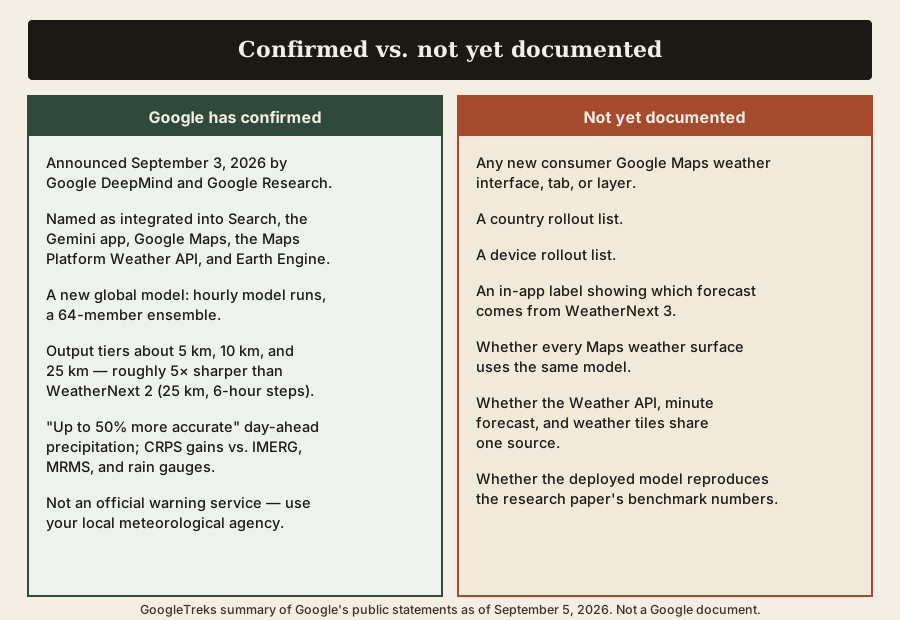
Confirmed: the announcement date; the list of named integrations including Google Maps; hourly model runs; the 64-member ensemble; the three output resolutions; the “five times sharper” spatial comparison; the precipitation figures with their named benchmarks; the clean-energy variables; data access through Earth Engine, BigQuery, and Cloud Storage; and Google’s own statement that this is not an official warning service.
The announcement gives no new consumer Maps weather interface, rollout schedule, country or device coverage, or in-app WeatherNext 3 forecast label.
What “integrated into Maps” actually establishes
Google’s announcement says WeatherNext 3 is one of the products it “is being integrated into,” alongside Search and Gemini. It does not describe a new Maps weather tab, a precipitation layer, a radar view, or a redesigned weather card. Independent coverage has read the consumer effect as an engine swap behind the existing weather card rather than a new feature; one outlet put it as the weather card “quietly got a new engine behind it.” That interpretation is reasonable, but it is the outlet’s framing, not a Google statement.
A country, app version, or Maps screen alone does not identify which forecasts use WeatherNext 3; no rollout list or in-app model indicator is given in the announcement.
The product surfaces are not interchangeable
Consumer Maps, Weather Lab, developer APIs, and bulk datasets serve different users; do not assume they share one production data path. Check the access requirements and coverage for the service you want to use.
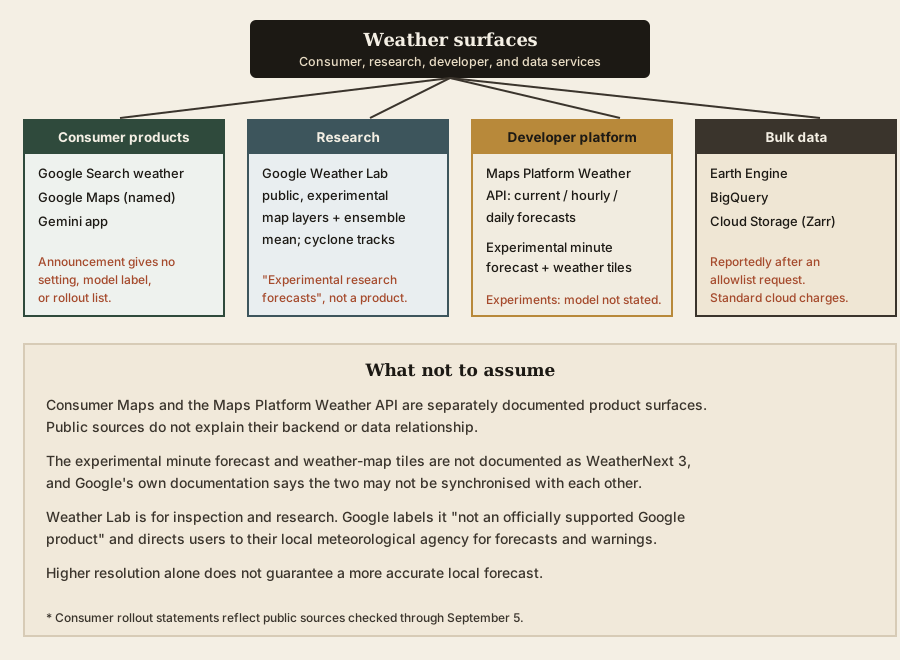
| Surface | Audience | What Google confirms | Access and stage | Do not assume |
|---|---|---|---|---|
| Consumer Google Maps | Everyone using the Maps app or site | Named as a product WeatherNext 3 "is being integrated into" | No action needed; no subscription; rollout not documented | A new weather layer, a rollout date, or that your country and device are covered today |
| Google Search weather | Search users | "Powering weather experiences within Google Search" | Live in the existing weather result | A visible change or a model label |
| Gemini app | Gemini users | Named integration | Within Gemini's answers | That a Gemini weather answer and a Maps card are identical |
| Google Weather Lab | Researchers, forecasters, enthusiasts | WeatherNext 3 layers, 1-hour steps, 64-member ensemble, 15-day horizon, cyclone tracks | Public website; no login required; "experimental research forecasts, not an officially supported Google product" | That it provides official forecasts or warnings, or that every region has the same live coverage |
| Maps Platform Weather API | Developers | Google Maps Platform states the Weather API "now powers forecasts" with WeatherNext 3; endpoints for current conditions, hourly to 240 hours, and daily to 10 days | Paid API key and Google Cloud project | That the API reference names a model, or that it returns exactly what the consumer app shows |
| Experimental minute forecast | Developers | Minute-by-minute precipitation nowcast for a 6-hour window; marked "Experimental (pre-GA)" | Pre-GA terms | That it is WeatherNext 3; the docs do not say so |
| Experimental weather map tiles | Developers | A separate experimental feature; Google's docs say minute forecasts "may not be synchronized or align with weather map tiles" | Pre-GA | That the tiles are WeatherNext 3, that they cover every region, or that the consumer app shows them |
| Earth Engine, BigQuery, Cloud Storage | Research and enterprise data users | Operational forecast data available; Cloud Storage in Zarr format | Reporting indicates access after an allowlist request; standard Google Cloud query, storage, and egress charges normally apply | That the data is free or instantly available, or that it matches the paper's research configuration exactly |
Weather Lab: what you can actually inspect
Weather Lab is the one surface where a member of the public can look directly at WeatherNext 3 output. It is a map-based research site that visualizes gridded global layers. For WeatherNext 3, Google’s guide lists 2-metre temperature, total precipitation, 10-metre wind speed, and sea level pressure, shown as an ensemble mean, with 1-hour time steps and a 15-day horizon. It also tracks tropical cyclones using a separate model, WeatherNext Cyclones, with predicted and observed tracks and per-member tracks.
Google is explicit about the status: “These are experimental research forecasts, not an officially supported Google product,” and “For official weather forecasts and warnings, refer to your local meteorological agency.” Weather Lab is useful for understanding what the model produces. It is not a place to make decisions that matter for safety, travel, agriculture, or energy.
“Five times sharper” is about resolution, not skill
Google’s phrase is “a global weather picture roughly five times sharper than our previous model.” That is a statement about spatial resolution: WeatherNext 2 ran on a single 25 km grid, and WeatherNext 3 produces finer grids for some variables. It is not a claim that forecasts are five times more accurate.
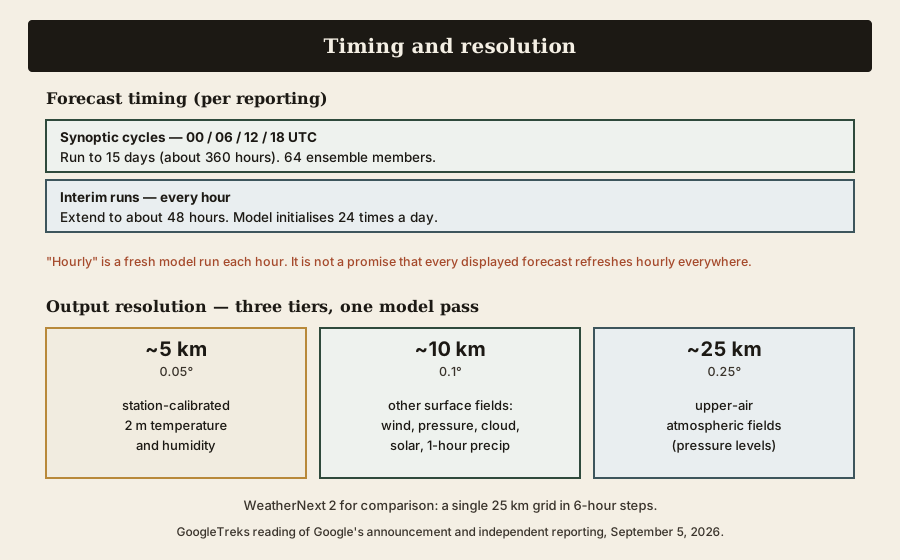
Resolution and horizons in more detail, drawing on Google’s announcement and technical reporting of it:
- The model initializes 24 times a day. The 00, 06, 12, and 18 UTC cycles run out to 15 days (about 360 hours) with 64 ensemble members. The interim hourly runs extend to roughly 48 hours.
- Outputs come in tiers: about 5 km (0.05°) for station-calibrated 2-metre temperature and humidity; about 10 km (0.1°) for other surface fields including 10-metre and 100-metre wind, pressure, sea surface temperature, cloud layers, solar radiation, and 1-hour precipitation; and about 25 km (0.25°) for upper-air atmospheric fields.
- “Hourly” refers to model initialization. Google has not said that every forecast shown in every product updates every hour in every place.
A sharper grid can place a shower over one valley instead of the next one, which matters. It does not by itself mean the forecast is right more often. Whether a specific local forecast improves depends on the variable, the lead time, the region, and the weather situation.
The precipitation numbers, in context
Two figures are circulating, and they measure different things.
The consumer-facing figure is “up to 50% more accurate precipitation forecasts” when “planning a day or more ahead,” with “the greatest improvements in regions where forecasts have historically been less reliable.” “Up to” and “greatest improvements in [some] regions” both signal that the gain is uneven.
The technical figure is a CRPS improvement “of up to 60% against IMERG, 30% for MRMS, and 10% against rain gauge measurements.” CRPS is a score for probabilistic forecasts; it rewards forecasts whose stated uncertainty matches what actually happens. It is an aggregate measure against specific reference datasets, not a single “accuracy” percentage, and the improvement against rain-gauge measurements — arguably the closest proxy for what falls on a specific spot — is the smallest of the three, at about 10% at short lead times.
None of this means a given afternoon’s rain forecast for a given town is now 50% better. It means that, measured against those datasets, the model’s precipitation forecasts score better on average, more so in places that were previously poorly served.
Consumer Maps versus the Maps Platform
Google Maps’ consumer weather experience and the Google Maps Platform Weather API are separately documented product surfaces. The Weather API is a developer service called with an API key from a Google Cloud project; Google Maps Platform says it now powers forecasts with WeatherNext 3, while the API reference does not name the model. Google’s public documentation does not explain whether or how the consumer Maps weather card shares backend systems or data with that API.
The experimental minute forecast—a six-hour precipitation nowcast—and experimental weather map tiles are Maps Platform features marked pre-GA. Google warns that the minute forecast may not align with the tiles. The documentation does not identify either feature as WeatherNext 3 or explain its relationship, if any, to the consumer Maps display.
WeatherNext 2 has not gone away
WeatherNext 3 is described as an ensemble model in the same probabilistic family as WeatherNext 2. Google’s current model guide continues to list WeatherNext 2 and says older models remain available for research and benchmarking. That does not mean every earlier forecast dataset remains active: Google’s release notes say the WeatherNext Gen (GenCast) and WeatherNext Graph (GraphCast) forecast datasets were deprecated on July 29, 2026, with active workflows migrated to WeatherNext 2 or 3. Launch reporting says on-demand custom inference still used WeatherNext 2; Google’s developer page does not name a version.
Weather safety
Do not use this report for forecasts, severe-weather guidance, or safety-critical decisions. Google itself attaches a disclaimer to the announcement: “For official weather forecasts, severe weather warnings, and public safety advisories, please refer to your local meteorological agency or national weather service.” Weather Lab repeats it. For warnings and advisories, use your national meteorological service and local emergency authorities. For a driving trip, our route-weather guide helps organize those checks around the journey.
For educators and map users
For a media-literacy or geography lesson, this announcement is a useful case study in reading a technology claim carefully: separating what a company confirms from what a headline implies, distinguishing resolution from accuracy, and noticing when “integrated into Maps” is doing more rhetorical work than the evidence supports. For practical class mapping, use the Google My Maps CSV-import guide or compare tools for your mapping task.
What to watch next
Concrete signals that would sharpen this story:
- A Google consumer help article or Google Maps release note that names WeatherNext 3.
- A rollout list by country or device, or an in-app indicator of forecast source.
- Weather API reference documentation that names the underlying model.
- Confirmation about whether the experimental minute forecast and weather tiles use WeatherNext 3.
- A statement on whether on-demand custom inference has moved to WeatherNext 3.
- Independent, large-scale evaluation of the operational model’s accuracy by region and variable.
- Any Google correction or revision to the September 3 announcement.
Timeline
- September 3, 2026 — Google DeepMind and Google Research announce WeatherNext 3 and name Search, the Gemini app, Google Maps, the Maps Platform Weather API, and Earth Engine as integrations. Google Maps Platform separately says the Weather API “now powers forecasts” with the model.
- September 5, 2026 — The Maps Guide publishes this report.
The Maps Guide is independent. It is not a Google product and is not affiliated with Google LLC.
The Maps Guide background reading: check weather along a driving route for a planning checklist that includes passage times, forecasts and official road notices.


